How-To·8 min read
What Is a Self-Transfer Flight, and Is It Safe?
Self-transfer flights are cheaper because the airline owes you nothing: what you give up, the bag and visa traps, when a self-transfer is fine, and how to tell if your booking is one.
PJPriyansh JainPosted June 27, 2026PJPriyansh JainFounder, GetStopoverPriyansh builds GetStopover: the stopover program registry, the eligibility checks, and every guide here, written from the airlines' own rules.View profilePriyansh on XGetStopover on X
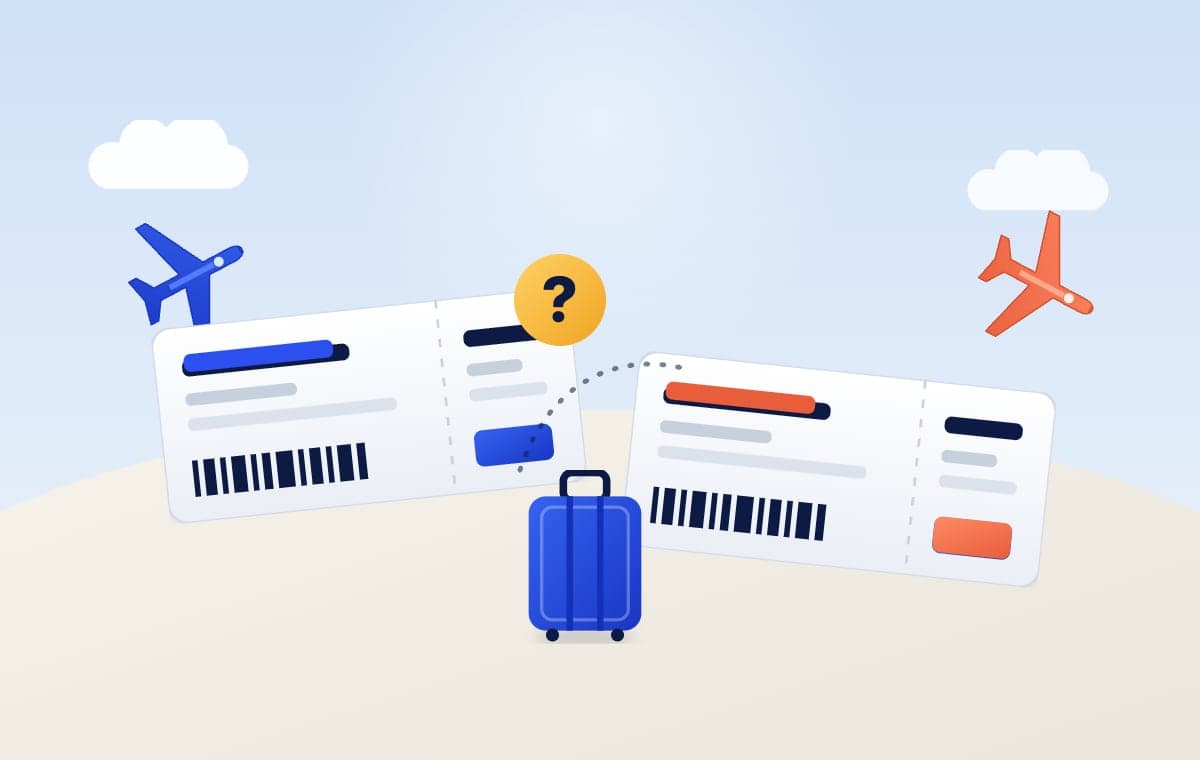
A self-transfer flight is two separate tickets stitched into one itinerary by a booking site, with a connection you are responsible for making on your own. It usually shows up because it is cheaper: aggregators like Kiwi.com combine flights from airlines that do not normally connect, and the price can undercut a normal one-ticket routing by a wide margin. The question travelers ask, and the one this answers, is whether that saving is worth the risk. The honest version is that a self-transfer can be perfectly fine, or it can strand you with a missed flight and a new ticket to buy, and which one you get comes down to a few things you can check before you book.
The protection you give up
The difference that matters is protection. On a normal connecting flight the whole journey sits on one ticket, and the airline is responsible for getting you to the end: if your first flight is late and you miss the second, they rebook you for free. A self-transfer carries none of that. Because each leg is a separate ticket, as far as either airline is concerned you booked two unrelated trips. There is no protection if the first leg is delayed, no obligation to rebook you, and no coordination between the two carriers at all. You are the only thing connecting them.
Why the risk is financial
That is what makes the real risk financial, not just stressful. If you miss the second flight because the first ran late, nobody owes you a rebooking, and you buy a new ticket at the counter at the walk-up fare. That walk-up fare is often several times what you paid, and it can erase the saving that made the self-transfer attractive in the first place. The cheaper itinerary on the results page can quietly be the expensive one in reality. A short self-transfer is not a small gamble, it is the whole second ticket.
Your bags become your problem
Your bags are part of the problem. On a self-transfer your checked bag is almost never tagged through to your final destination: it comes out at the connecting airport, you collect it, and you check it in again for the second flight. If that connection is your point of entry into a country, you also clear immigration and customs in between, which adds a slow, unpredictable queue right in the middle of an already tight window. Traveling with only a carry-on removes a large chunk of this risk, which is why experienced self-transfer travelers avoid checking bags whenever they can.
The hidden visa trap
There is a trap here that catches people who assume they are only passing through. On many self-transfers you do not stay airside, you are made to enter the country at the connecting airport, which can require a transit or entry visa you would not need on a single through-ticket. A connection that would be visa-free as a protected transit can require a visa the moment it becomes a self-transfer, because you are formally entering and re-departing. Check the visa rules for your connecting country on your specific passport before you assume you can simply walk between gates.
Perks that vanish on separate tickets
Self-transfers also quietly strip benefits that ride on the ticket. Lounge access, priority, and elite perks are tied to the booking, so a premium-cabin or status traveler can find themselves denied at the connecting airport because the second leg is a different ticket entirely. Airline stopover programs, free-hotel benefits, and through-fare protections work the same way: they are almost always void on separate tickets. If part of the appeal was a perk, confirm it survives the split before you count on it.
When a self-transfer is fine
None of this means self-transfers are always a bad idea. A self-transfer is reasonable when the buffer is generous, you carry only hand luggage, and the connecting country is visa-free for you. Give yourself far more time than you would on a protected connection, because the whole point is that no one is holding the second flight for you. Many seasoned travelers treat the first leg as the one likely to slip and refuse to self-transfer on a tight gap. If the legs are on the same airline or alliance, it is worth asking whether they can be sold as a single ticket instead, which restores the protection for often little extra money.
How to spot a self-transfer
Telling whether you are even looking at a self-transfer is half the battle, because the booking page rarely says it loudly. The tells are separate confirmation numbers, a label like "self-transfer" or "virtual interline," and bags checked only to the connecting city rather than your final destination. If you receive two booking references instead of one, that is the signal. When in doubt the rule is simple: one ticket means the airline owns the connection, two tickets means you do.
If it breaks, you are on your own
If a self-transfer does break, know going in that you are on your own. The first airline's duty ends when it lands you, late or not, and the second airline sees a passenger who simply did not show up. Your only real protections are the buffer you built yourself and, for bigger trips, travel insurance that specifically covers missed connections on separate tickets. Standard airline rebooking is not coming, so the time to manage the risk is before you book, not at the gate.
How GetStopover flags it
The hard part is that all of this is invisible on a results page built to show you the lowest number. Whether an itinerary is one ticket or two, whether the bag re-checks, whether you need a visa to clear the connection, none of it is obvious until you are already committed. That is exactly what GetStopover checks before you book: it flags when a connection is a self-transfer rather than a protected one, and calls out the bag-recheck and visa traps in plain language instead of leaving them buried in fare rules. The saving might be real, but you want to choose it with your eyes open, not discover the catch airside with a gate closing.
Frequently asked questions
What is a self-transfer flight?
A self-transfer is two separate tickets stitched into one itinerary by a booking site, with a connection you are responsible for making yourself. Because the legs are separate tickets, the airlines treat them as two unrelated trips.
Are self-transfer flights safe?
They can be fine with a generous buffer, hand luggage only, and a visa-free connecting country. The risk is that if you misconnect, no one rebooks you and you buy a new ticket, so a too-tight self-transfer can cost far more than it saved.
Do I have to collect and re-check my bags on a self-transfer?
Almost always yes. On separate tickets your bag is rarely checked through, so you collect it at the connecting airport and check it in again, often clearing immigration and customs in between.
How do I tell if my flight is a self-transfer?
The tells are two separate booking references instead of one, a "self-transfer" or "virtual interline" label, and bags checked only to the connecting city rather than your final destination.
More guides
All guides
How-To · 10 min read
Can You Leave the Airport During a Layover? Doha, Dubai, Abu Dhabi, Singapore and Istanbul, by Passport
Whether you can step outside on a layover comes down to three things: your passport, the hours you actually have after immigration and the trip to town, and what happens to your bags. The answer for five hubs, passport by passport, with what each airline gives you if you go.
PJPriyansh JainPosted September 17, 2026PJPriyansh JainFounder, GetStopoverPriyansh builds GetStopover: the stopover program registry, the eligibility checks, and every guide here, written from the airlines' own rules.View profilePriyansh on XGetStopover on X

How-To · 7 min read
Layover vs Stopover: What's the Difference?
Layover and stopover aren't the same thing, and the difference is worth a free hotel: what each term means, the 24-hour line that separates them, and how a long layover or a multi-day stopover turns a connection into a free second trip.
PJPriyansh JainPosted July 6, 2026PJPriyansh JainFounder, GetStopoverPriyansh builds GetStopover: the stopover program registry, the eligibility checks, and every guide here, written from the airlines' own rules.View profilePriyansh on XGetStopover on X
How-To · 8 min read
How Long Should a Layover Be? Minimum Connection Times Explained
How long a layover really needs to be: what minimum connection times do and don't guarantee, the self-transfer mistake that costs hundreds, and the 2026 EU border queues now breaking tight connections.
PJPriyansh JainPosted June 26, 2026PJPriyansh JainFounder, GetStopoverPriyansh builds GetStopover: the stopover program registry, the eligibility checks, and every guide here, written from the airlines' own rules.View profilePriyansh on XGetStopover on X

Stop flying past
free hotels.
Free. Works on Google Flights, Skyscanner, Kayak and Expedia.