How-To·8 min read
How Long Should a Layover Be? Minimum Connection Times Explained
How long a layover really needs to be: what minimum connection times do and don't guarantee, the self-transfer mistake that costs hundreds, and the 2026 EU border queues now breaking tight connections.
PJPriyansh JainPosted June 26, 2026PJPriyansh JainFounder, GetStopoverPriyansh builds GetStopover: the stopover program registry, the eligibility checks, and every guide here, written from the airlines' own rules.View profilePriyansh on XGetStopover on X
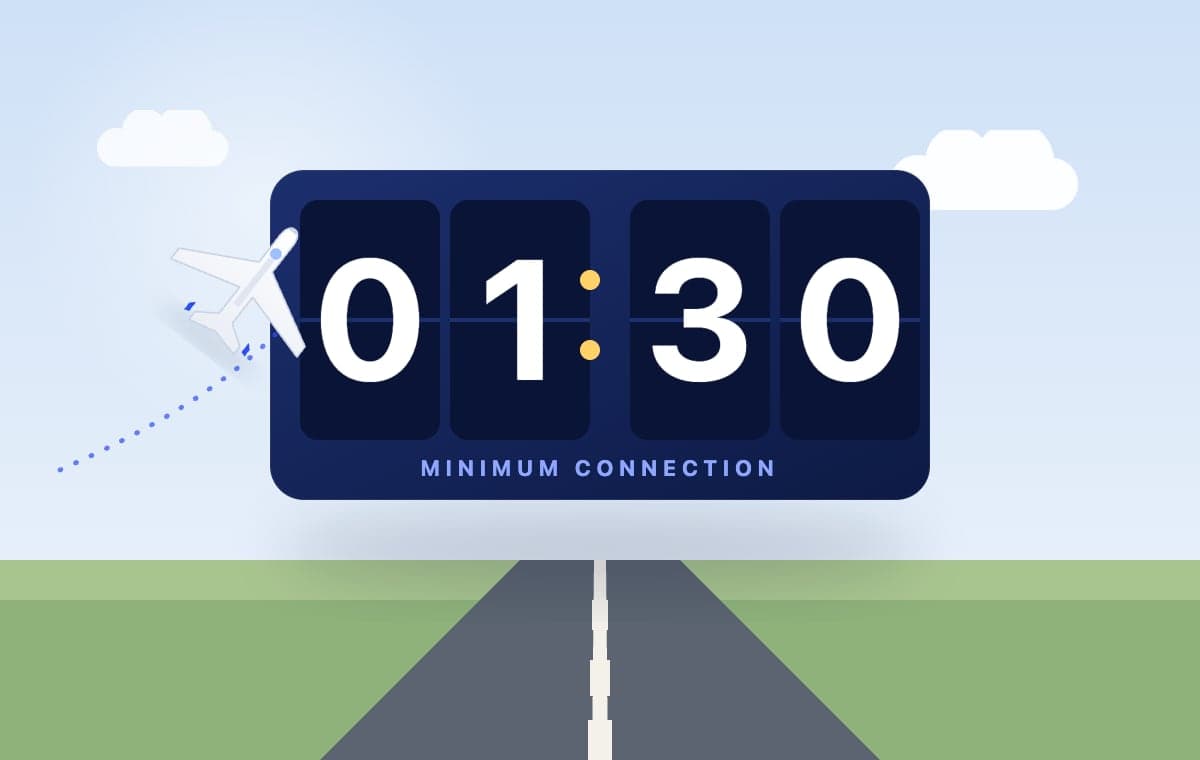
The most common question travelers ask before booking a connecting flight is also the one booking sites answer worst: is this layover long enough to actually make? A short connection looks efficient on the results page, gets you to your destination sooner, and often costs less. It also carries every minute of risk that the itinerary will fall apart the moment something runs late. The honest answer to "how long should a layover be" is that it depends on a handful of factors the search results never show you, and getting it wrong ranges from a stressful sprint across the terminal to buying a brand-new ticket out of pocket.
What a minimum connection time means
Every airport publishes a Minimum Connection Time, or MCT, for each airline and each type of connection: domestic to domestic, domestic to international, international to international. It is the shortest gap the airline's system will let you book on a single ticket. If a connection clears the MCT, the airline considers it legal and will sell it to you. The trap is what MCT actually represents: a best-case floor that assumes both flights run exactly on time, that you know precisely where you are going, and that nothing at the airport slows you down. It is the minimum the airline is willing to be responsible for, not the amount of time a careful traveler would leave.
Why a sold connection is not a guarantee
That points to the misconception worth correcting first, because it comes up constantly: "the airline sold me this connection, so it must be makeable." All a sold connection guarantees is that the gap met the MCT on paper. It says nothing about whether your inbound flight will land on time, whether your two gates sit at opposite ends of the airport, or whether weather three airports away has already set your aircraft back an hour. On a single ticket, clearing the MCT does buy you one real protection, covered below. It does not buy you a comfortable margin.
What really decides the time you need
What actually drives how much time you need is the shape of the connection, not a single magic number. A domestic-to-domestic connection in the same terminal, where you never touch security again, is the easy case. The minutes stack up fast when any of these apply: you change terminals or concourses, you clear passport control and customs because the connecting airport is your point of entry into the country, you re-check a bag after clearing customs, you pass back through security, or the airport is large, busy, and prone to delay. An international connection where you clear immigration, collect your checked bag, re-drop it, and re-clear security is a fundamentally different task from stepping off one domestic flight and walking to the next gate, and it needs far more cushion.
The self-transfer trap
The single most expensive mistake is treating a self-transfer like a normal connection. When your two flights sit on separate tickets, common with the cheap "hacker fare" and "self-transfer" itineraries that booking aggregators love to surface, the MCT does not apply at all, and neither does the airline's obligation to you. There is no system check that the gap is legal, because as far as each airline is concerned you booked two unrelated trips. You will almost always have to collect your checked bags and re-check them, often clear immigration in between, and if you miss the second flight, no one rebooks you for free. You buy a new ticket at the counter at whatever the walk-up fare happens to be. A self-transfer that looks twenty minutes tighter than a protected connection can quietly be the difference between a minor delay and several hundred dollars.
What a single ticket protects
On a single ticket, the protection you do get is real, and it is the reason the distinction above matters so much. If you misconnect because your first flight was late, the airline rebooks you on the next available flight at no charge, and if the delay was within their control, they may owe you meals or a hotel. So the practical rule is simple: a tight connection on one ticket is mostly a risk to your schedule and your nerves; a tight connection across two tickets is a risk to your wallet. Before you book anything that looks aggressively short, find out which one you are actually looking at.
Why EU hubs need more time in 2026
There is a specifically 2026 reason to add buffer at European hubs. As the EU rolls out its biometric Entry/Exit System (EES) at major airports, travelers transiting Schengen hubs on non-EU passports are reporting border-control queues long enough to swallow a connection whole. The pattern in traveler reports from Frankfurt, Amsterdam, and Paris this spring is consistent: a one or two hour connection that would have been fine a year ago is not anymore, because a non-EU passenger crossing the Schengen border in transit now faces a slow biometric check before reaching the onward gate. If you are transiting a major EU airport on a non-EU passport in 2026, treat the old comfort numbers as out of date and build in extra time, in hours rather than minutes.
Watch out for schedule changes
One more thing erodes a connection after you have already booked it: schedule changes. Airlines move departure and arrival times routinely, sometimes by minutes, sometimes by hours, and a connection that was comfortable when you booked can quietly turn marginal. The protection on a single ticket still applies, but the buffer you chose is gone, and the airline will not necessarily flag it for you. Re-check the gap every time you get a schedule-change email, and if a single-ticket connection has dropped below what you are comfortable with, that is grounds to ask the airline to move you to a better one at no charge.
So how long should it be?
As for the numbers people actually want: there is no universal minimum, only the airport-and-airline MCT, which you should look up for your specific connecting airport. What seasoned travelers lean on as rules of thumb, explicitly not official rules, runs roughly like this. For a domestic same-terminal connection, many will not book under about an hour, and prefer ninety minutes at a delay-prone hub. For an international connection where you clear immigration and re-check a bag, the common comfort floor is closer to two and a half or three hours, more if you are also changing airlines or terminals. These are margins for your own peace of mind, not guarantees. The official floor is the MCT, and the safe gap is whatever sits well above it for the specific airport, time of day, and passport you are traveling on.
Three checks you can do yourself
The reason all of this is so hard to judge from a results page is that the page hides exactly the variables that matter: whether the connecting airport is your immigration point, whether the bag re-checks, whether the two legs are even on the same ticket, and what the real MCT is. That is the gap GetStopover is built to close. Instead of guessing whether a layover is long enough, you see before you book whether your specific connection actually clears for your itinerary and your passport, with the self-transfer and immigration traps called out rather than buried. Three checks settle most of it on your own: confirm it is a single ticket or accept the self-transfer risk, look up the connecting airport's MCT and leave a wide margin above it, and add more time whenever you clear immigration or transit an EU hub in 2026.
Frequently asked questions
How long should a layover be?
There is no universal minimum, only the airport-and-airline Minimum Connection Time (MCT). As a rule of thumb, many travelers leave at least an hour for a domestic same-terminal connection, and two and a half to three hours for an international one where they clear immigration and re-check a bag.
Is a 1-hour layover enough?
For a domestic connection in the same terminal it can be, if it clears the airport MCT and both flights are on one ticket. For an international connection where you clear immigration, collect and re-check a bag, or change terminals, one hour is usually too tight.
If the airline sold me the connection, does that mean I will make it?
Not necessarily. A sold connection only means the gap met the airline Minimum Connection Time on paper, which assumes both flights run exactly on time. It does not guarantee a comfortable margin if anything is delayed.
What happens if I miss my connecting flight?
On a single ticket the airline rebooks you on the next available flight at no charge, and may owe meals or a hotel if the delay was their fault. On separate tickets (a self-transfer) no one rebooks you, and you buy a new ticket yourself.
More guides
All guides
How-To · 10 min read
Can You Leave the Airport During a Layover? Doha, Dubai, Abu Dhabi, Singapore and Istanbul, by Passport
Whether you can step outside on a layover comes down to three things: your passport, the hours you actually have after immigration and the trip to town, and what happens to your bags. The answer for five hubs, passport by passport, with what each airline gives you if you go.
PJPriyansh JainPosted September 17, 2026PJPriyansh JainFounder, GetStopoverPriyansh builds GetStopover: the stopover program registry, the eligibility checks, and every guide here, written from the airlines' own rules.View profilePriyansh on XGetStopover on X

How-To · 7 min read
Layover vs Stopover: What's the Difference?
Layover and stopover aren't the same thing, and the difference is worth a free hotel: what each term means, the 24-hour line that separates them, and how a long layover or a multi-day stopover turns a connection into a free second trip.
PJPriyansh JainPosted July 6, 2026PJPriyansh JainFounder, GetStopoverPriyansh builds GetStopover: the stopover program registry, the eligibility checks, and every guide here, written from the airlines' own rules.View profilePriyansh on XGetStopover on X

How-To · 8 min read
What Is a Self-Transfer Flight, and Is It Safe?
Self-transfer flights are cheaper because the airline owes you nothing: what you give up, the bag and visa traps, when a self-transfer is fine, and how to tell if your booking is one.
PJPriyansh JainPosted June 27, 2026PJPriyansh JainFounder, GetStopoverPriyansh builds GetStopover: the stopover program registry, the eligibility checks, and every guide here, written from the airlines' own rules.View profilePriyansh on XGetStopover on X

Stop flying past
free hotels.
Free. Works on Google Flights, Skyscanner, Kayak and Expedia.